Polkadot Builder Party Hackathon Report
Global Online Hackathon https://polkadot.devpost.com/
Oct 6th - Nov 17th (6 weeks)
Organizer: Technical Education Team, W3F
Planning Committee: OpenGov Watch, Polkadot Roots, Polkadot Editorial Board, Parity Technologies, Polkadot Africa, Distractive, W3F
Developer Support: W3F, Parity, Papermoon, OpenGuild, DevCult, Polkadot Africa
Design and marketing: polkadot.cloud, Distractive, W3F
Sponsors: Polkadot Events Bounty, and W3F
Prize pool: $40000
Tracks: User-centric Apps, Build a blockchain, and Polkadot Tinkerers
Registered Participants: 2746
Project Submissions: 238
Winners: 50
Judges: 12 (W3F, Parity, Papermoon, DevCult, Polkadot Africa)
Hackathon Overview
The global online hackathon is the centerpiece of the Polkadot Builder Party (which initially started as the Polkadot 2.0 Launch Party in June 2025), a broader effort within the Polkadot ecosystem with a shared purpose of attracting developers outside the crypto and Web3 bubble. By the end of June 2025, a core working group of five ecosystem teams came together to bootstrap this initiative:
- Coordination: Tommi (OpenGov.Watch)
- Hackathon: Radha (Web3 Foundation)
- Meetups: Tycho (Roots)
- Social: Evan (Social Media Editorial Board)
- Marketing: Eric (Distractive)
With the backing of Polkadot Events Bounty and the Web3 Foundation, the Devpost platform’s licensing costs and contracts were taken care of, and the broader hackathon’s marketing outreach activities were bootstrapped by the end of August 2025 with a planning committee of 18 members and a hackathon support group of 50 members.
Hackathon Objective
The primary goals for the hackathon organizing team (W3F Technical Education team) were to:
- Collect Polkadot DevEx feedback from developers outside of the Blockchain/Web3 ecosystems.
- Let developers tinker with Polkadot SDK, APIs, and libraries to build user-centric applications.
- Report developer feedback to the Polkadot Technical Fellowship and the Polkadot Ecosystem DevRel teams across Parity, Papermoon, and OpenGuild
Hackathon Metrics
The registration and project submission process involved answering a mandatory questionnaire about their developer background, perception about Polkadot and Web3, and providing feedback regarding Polkadot developer documentation and Polkadot DevEx in general.
1709 out of 2746 participants (62%) self-reported that this was their first Blockchain/Web3 hackathon, which we consider a decent success metric for our primary objective of reaching developers who were experiencing blockchain development for the first time. This was primarily facilitated by the Devpost platform, which brought in 865 participants, as well as the collective marketing efforts and the Polkadot Roots meetups across the globe. The demographics of the participants show significant engagement in Asia, Africa, and North America.
| Rank | Country | Registrants | Submitters | Conversion % |
|---|---|---|---|---|
| 1 | India | 1,143 | 81 | 7.09% |
| 2 | Nigeria | 177 | 30 | 16.95% |
| 3 | United States | 142 | 20 | 14.08% |
| 4 | Kenya | 108 | 27 | 25.00% |
| 5 | Ethiopia | 98 | 14 | 14.29% |
| 6 | Canada | 84 | 16 | 19.05% |
| 7 | Tanzania (United Republic of) | 38 | 5 | 13.16% |
| 8 | Germany | 30 | 5 | 16.67% |
| 9 | Pakistan | 30 | 3 | 10.00% |
| 10 | Indonesia | 29 | 6 | 20.69% |
227 teams shared comprehensive feedback on Polkadot DevEx during the submission phase. A comprehensive feedback analysis has been shared with Parity’s DevEx team.
Hackathon Submissions and Winners
Submissions by track
-
Build a blockchain: 35 submissions
- User-centric Apps: 155 submissions
- Polkadot Tinkerers: 49 submissions
Verticals:
DeFi: 103 projects (43.1%)
- The largest category, including DEXs, swaps, lending, staking platforms
NFT/Gaming: 40 projects (16.7%)
- Games, NFT platforms, metaverse, collectibles
ZK/Zero-Knowledge: 28 projects (11.7%)
- Privacy-preserving tech
Identity/Reputation: 22 projects (9.2%)
- DIDs, credentials, reputation systems, authentication
AI/ML: 19 projects (7.9%)
- AI agents, machine learning applications
Supply Chain: 8 projects (3.3%)
- Logistics, tracking, provenance
IoT: 7 projects (2.9%)
- Internet of Things, sensors, devices
Other: 6 projects (2.5%)
- Miscellaneous projects that don’t fit other categories
Privacy: 4 projects (1.7%)
- Privacy-focused (non-ZK) solutions
DAO/Governance: 2 projects (0.8%)
- Governance and DAO platforms
Tech Stack used:
- Polkadot SDK: 58 (24.3%)
- ink!: 37 (15.5%)
- Solidity: 81 (27.2%)
- Deployed on Moonbeam / Moonbase: 47 (19.7%)
- Deployed on PAsset Hub: 33 (13.8%)
- Polkadot.js: 79 (33.1%)
- PAPI: 9 (3.8%)
Winners:
Build a blockchain track:
1st Prize: Agora
A verifiable off-chain computation marketplace built as a Polkadot parachain.
Built using Polkadot SDK with FRAME framework and custom pallets (specifically the agora pallet). Uses XCM for cross-chain messaging and Off-Chain Workers (OCW) for computation.
2nd Prize: Polka Blue
Decentralized Proof of Location system using Bluetooth RSSI measurements to verify physical location.
Built using Polkadot SDK with FRAME and a custom pallet-proof-of-location. Uses Aura + GRANDPA consensus with off-chain workers and Subxt for integration.
3rd Prize: Era
Media authenticity verification platform (blockchain-based “ledger of reality”) for proving photo/video authenticity.
Built using Polkadot tools, including FRAME, chain-spec, omni-node, and pop-cli.
3rd Prize: Cloak
Privacy layer for cross-chain asset transfers using zero-knowledge cryptography.
Built using Polkadot SDK with a custom privacy-bridge pallet and XCM v5.
User-centric Apps track:
1st Prize: Nani
Event monitoring and notification service for Polkadot chains with real-time alerts.
Built using PAPI with Node.js and TypeScript. Features a plugin system for extensibility and connects to multiple chains via WebSocket.
2nd Prize: Chopdot
Group expense tracking and settlement app using DOT payments on Polkadot Asset Hub.
Built using PAPI for Asset Hub integration. Supports multiple wallets (Polkadot.js, SubWallet, Talisman, WalletConnect) and uses IPFS/Crust for decentralized storage.
3rd Prize: Ocean Fin
Automated DeFi yield optimization platform for Polkadot.
Built using Dedot with integration to Polkadot Asset Hub and Hydration parachain for yield strategies.
3rd Prize: TravelID 2.0
Decentralized travel document verification platform.
Built using Subxt for Polkadot integration with a Rust backend (Axum, SQLx). Uses system remarks to store document hashes on-chain. Frontend uses Polkadot.js for wallet integration.
Polkadot Tinkerers track:
1st Prize: Fangorn
A permissionless threshold encryption network enabling decentralized conditional access control (witness encryption) for token-gated content. Built with Polkadot SDK for the protocol, and ink! Smart contracts for on-chain intent registry.
2nd Prize: ANTS
Blockchain infrastructure for cryptographic video authentication to preserve reality when AI can manufacture fake videos. Built with Polkadot SDK with a custom video-registry pallet. Uses Aura + GRANDPA consensus. Frontend uses Polkadot.js.
3rd Prize: iVF
Automated generation of ink! v6 smart contract verifiers from Noir zero-knowledge proof circuits for PolkaVM. Built with ink! and PolkaVM.
3rd Prize: PolkaShield
Turns any Web2 app into a tamper-proof, portable, user-owned identity and permissions system on Polkadot. Built with Polkadot SDK using the solochain template with three custom FRAME pallets.
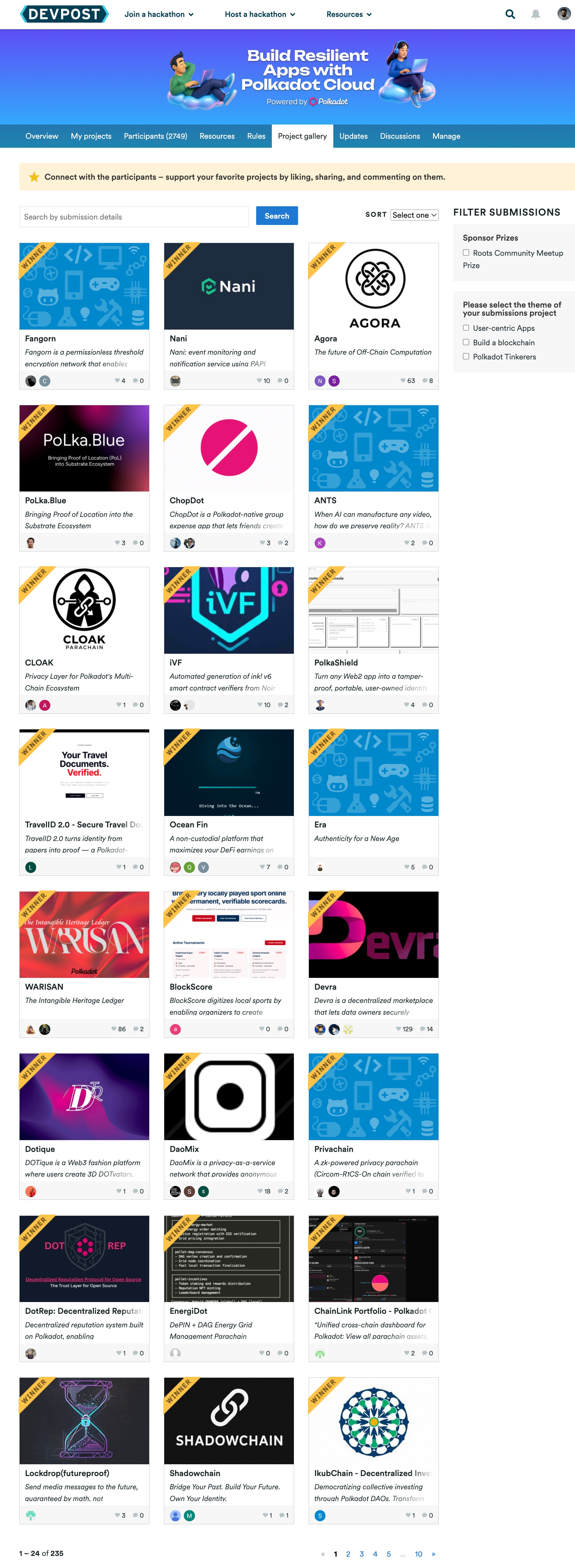
View the list of 50 winners of the Polkadot Builder Party hackathon here https://polkadot.devpost.com/project-gallery
What’s next?
With smart contracts launching on Polkadot right around the corner, it is important to gather early DevEx feedback on developer tooling and infrastructure. The Web3 Foundation Technical Education team is collaborating with OpenGuild and the Parity DevEx team to organize a 6-week global online hackathon in Q1 2026 to bring smart contract developers to tinker with smart contract infrastructure
on Polkadot.
The collective hackathon efforts yielded an active developer community group on Telegram, comprising over 350 members. https://t.me/+kXt6ERV4U6c3ZjM8 We will continue to grow this developer community further. We will also work on the feedback collected regarding the Polkadot developer docs and tutorials to ensure that participants in the smart contracts global hackathon have a seamless onboarding experience in Q1 2026.
