Appendices A-E
This is a continuation of the main proposal post above. Please read the main post first for context.
These appendices provide detailed implementation plans, working group structures, responsibility assignments, and supporting information for the governance commitments outlined in the main proposal.
Appendix A: Addressing Common Misconceptions
Based on discussions from the Polkadot Forum post and a subsequent community discussion on X kindly hosted by Hope Clary, several misconceptions about the PAF extension pallet should be clarified:
-
Scope: The PAF extension pallet is not attempting to solve all governance problems at once or make the Ambassador Fellowship “purely” on-chain. It contains approximately 15 targeted extrinsics and 20 events designed to address specific governance risks identified through experience with the program.
-
Hybrid Approach: The proposal represents a hybrid on-chain/off-chain approach, not a complete decentralization of all Ambassador functions. It focuses on implementing critical governance safeguards while maintaining operational flexibility.
-
Risk Mitigation: The PAF extension pallet was developed with inspiration from “safety in design” principles, but as noted in the disclaimer, no formal methodology was fully followed nor has a Web3-specific equivalent been created yet. The approach focused on addressing governance risks that were personally identified as important based on experience with the program.
-
Technical Readiness: The code has been iteratively tested and refactored, but requires proper security review under NDA due to potential dual-use concerns.
-
Practical Experience: The design is informed by both technical experience (parachain deployment, Parity work) and governance experience (project design management, risk workshop facilitation).
The governance commitments being voted on represent practical steps to ensure responsible implementation rather than barriers to progress.
Appendix B: Collaborative Implementation Approach
As noted by community members in the forum discussion, implementing these governance safeguards should be a collaborative effort rather than the responsibility of a single individual. The following structured approach distributes responsibility appropriately while ensuring comprehensive implementation of governance safeguards:
-
Working Group Structure and Composition:
-
Common Accountability Standards for All Working Groups:
- Formal commitment to specific deliverables and time allocation
- Clear performance metrics with monthly review
- Replacement mechanism if participation falls below 75% of scheduled meetings
- Public commitment to the PAF governance principles
- Membership primarily from ambassadors who voted to support on-chain implementation
- Inclusion of some representatives who had concerns or voted against on-chain implementation to ensure diverse perspectives
-
Working Group Member Selection Process:
- Transparent application and evaluation process open to all verified ambassadors
- Selection criteria based on:
- Relevant technical/governance/communication expertise for the specific working group
- Demonstrated commitment to the Polkadot ecosystem
- Previous contributions to ambassador governance discussions
- Ability to commit required time over the implementation period
- Balance of perspectives (including representation from those with concerns)
- Selection committee composed of 3 ambassadors elected by the collective
- Public evaluation rubric with scoring for each criterion
- All applications and evaluations published for transparency
- Appeals process for rejected applications
- Commitment Checklist: The Ambassador Fellowship Commitment Checklist (v0.2) mentioned here Transition to the On-Chain Collective: Next Steps for the Ambassador Fellowship - #9 by ltfschoen will be finalized with inputs from the ambassador fellowship and community, then used to evaluate and score each contributor throughout the implementation process, providing feedback for continuous improvement
- Responsible: Ambassador Fellowship Coordinator to organize election of selection committee
-
PAF Governance Working Group: Core coordinating body (5-7 members)
- Includes the Ambassador Fellowship Coordinator (elected position)
- Responsible for overall coordination and integration of all governance work
- Maximum size: 7 members to ensure efficient decision-making
-
PAF Technical Working Group: Technical implementation specialists (3-5 members)
- Composed of technically skilled ambassadors
- May include 1-2 advisors from Technical Fellowship (non-voting) with:
- Additional requirement: Explicit acknowledgment of advisory responsibilities in Technical Fellowship meeting minutes
- Responsible for code review, technical documentation, and security coordination
- Maximum size: 5 members focused on technical implementation
-
PAF Communications Working Group: Community engagement specialists (3-5 members)
- Responsible for facilitating community discussions and feedback collection
- Manages documentation of community input and publication of updates
- Maximum size: 5 members focused on communication and documentation
-
PAF Treasury Management Working Group: Resource allocation specialists (3 members)
- Responsible for budget planning and resource allocation
- Coordinates with PAL and other security providers on funding arrangements
- Maximum size: 3 members with treasury management experience
-
PAF Values Assurance Working Group: Values alignment specialists (3-5 members)
- Responsible for evaluating alignment with ambassador values and providing constructive feedback
- Conducts random audits using the Commitment Checklist as a standard
- Manages the witness-based verification system for Alignment Scores
- Provides mentorship during remediation periods
- Coordinates the recognition program for exemplary values demonstration:
- On-chain NFT badges, public recognition, and priority consideration for future governance roles
- Sponsorship Program:
- Funding sources: ecosystem parachains, aligned Web3 companies, and community micro-donations
- Transparent sponsorship guidelines to prevent conflicts of interest
- All sponsors publicly acknowledged with clear separation between sponsorship and governance
- All recognition activities to be funded through future sponsorships and community contributions once initial treasury funding is established (no additional treasury funding beyond the initial proposal)
- Responsible: PAF Values Assurance Working Group with support from PAF Communications Working Group
-
-
Timeline Estimation:
- Target implementation: 3 months with focused effort and adequate resources
- Commitment timeline: All safeguards completed within 90 days of on-chain approval as specified in the Governance Safeguards Timeline commitment
- Contingency planning: Additional 3 months reserved only for unforeseen circumstances (security review delays, technical challenges, or governance process requirements) that would require formal extension approval
- Critical safeguards: Prioritized for implementation within first 30 days as specified in the Governance Safeguards Timeline commitment
- Key Milestone: Finalization of the Ambassador Fellowship Commitment Checklist (v0.2) with community input within the first 30 days, to be used for ongoing contributor evaluation and continuous improvement
- Responsible: Ambassador Fellowship Coordinator to organize election of selection committee
-
Cross-Functional Expertise: Include members with diverse backgrounds covering technical, legal, social, and cultural operational requirements
-
Community Discussion Venues: Continue discussions in appropriate forums including Polkadot Forum and Sub0 Argentina events
-
Cross-Collective Approach: Encourage each collective in the Polkadot ecosystem to analyze requirements from their unique perspective and expertise
-
Critical Governance Questions Responsibilities:
- Emergency Response Protocols: PAF Governance Working Group with input from Security Experts
- Accountability Mechanisms: PAF Governance Working Group with PAF Technical Working Group
- Privacy and Legal Framework: PAF Communications Working Group with legal advisors
- Balanced Power Distribution: PAF Technical Working Group with PAF Governance Working Group
- Dual-Use Risk Management: PAF Technical Working Group with Security Experts
-
Key Deliverables Responsibilities:
- Comprehensive Documentation:
- Responsible: PAF Communications Working Group with input from all groups
- Manifesto Amendments:
- Responsible: PAF Governance Working Group with input from independent technical experts
- Accountability Mechanisms:
- Responsible: PAF Governance Working Group with PAF Technical Working Group
- Terms of Use Updates:
- Responsible: PAF Communications Working Group with legal advisors
- Technical Fellowship RFC:
- Responsible: PAF Technical Working Group with independent technical experts
- WFC Preparation:
- Responsible: PAF Governance Working Group with PAF Communications Working Group
- Pallet Functionality Control:
- Responsible: Technical Fellowship via Root track governance
- Comprehensive Documentation:
-
Estimated Time Commitments and Rank-Based Rates:
-
Rank-Based Hourly Rates (aligned with Technical Fellowship structure):
- Rank I: $40/hour
- Rank II: $60/hour
- Rank III: $80/hour
- Rank IV: $100/hour
- Note: Working groups will include members from multiple ranks based on expertise requirements
-
PAF Governance Working Group Members:
- All Phases: 4-8 hours per week (compensation based on rank)
- Total Estimated Cost varies by rank and will be calculated based on actual working group composition
- Key Milestones: Working group formation, security review coordination, accountability mechanism design
-
PAF Technical Working Group Members:
- All Phases: 4-8 hours per week (compensation based on rank)
- Total Estimated Cost varies by rank and will be calculated based on actual working group composition
- Key Milestones: Security review preparation, technical documentation, RFC preparation
-
PAF Communications Working Group Members:
- All Phases: 4-8 hours per week (compensation based on rank)
- Total Estimated Cost varies by rank and will be calculated based on actual working group composition
- Key Milestones: Documentation preparation, community feedback collection, Terms of Use updates
-
PAF Treasury Management Working Group Members:
- All Phases: 4-8 hours per week (compensation based on rank)
- Total Estimated Cost varies by rank and will be calculated based on actual working group composition
- Key Milestones: Resource planning, security audit funding coordination
-
Independent Technical Documentation:
- The PAF Technical Working Group will engage independent technical experts not affiliated with the Ambassador Fellowship to:
- Document the original design decisions and implementation details of the PAF extension pallet
- Provide technical guidance on implementation requirements
- Support the Technical Fellowship RFC process
- Deliver key milestones including manifesto amendments, technical documentation, RFC preparation, and security review support
- Establish a formal knowledge transfer process with comprehensive documentation of design decisions and implementation details
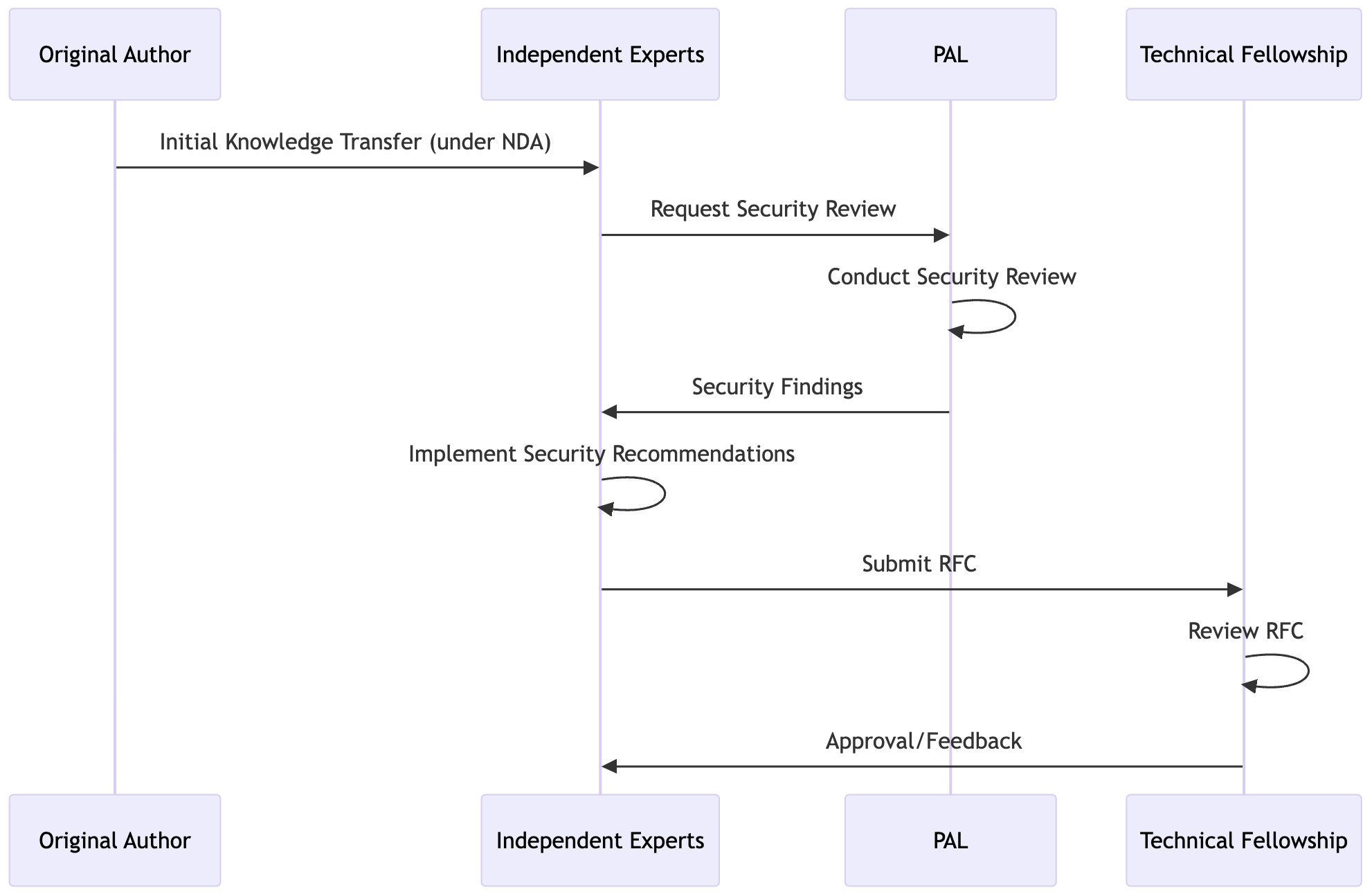
- Initial Knowledge Transfer: The original PAF extension pallet author will provide the existing PAF extension pallet code and proposed manifesto annexes under NDA as a one-time necessary involvement, with these materials being subject to an open-source share-alike license requiring proper attribution, treated as legacy documents that may be updated by independent technical experts, and only after security review clearance, published with appropriate attribution to serve as reference materials for the proposal.
- Note: These independent technical experts will work under appropriate NDAs with PAF Governance Working Group approval, ensuring all necessary work is completed while respecting the conflict of interest constraints
- Note: Beyond this initial knowledge transfer, the original PAF extension pallet author will not be involved in any aspect of the implementation, review, or documentation process due to the conflict of interest that arises from being an ambassador while reviewing ambassador fellowship related collective code, as highlighted by the Parity Bug Bounty team’s determination. This approach acknowledges the general principle that individuals with formal affiliations to a collective should not be involved in security review of that collective’s code, ensuring independent assessment.
- Note: With these governance commitments in place, the original author can continue active participation in the Ambassador Fellowship without needing to pause membership, as previously considered. The governance safeguards outlined in this document proactively address the concerns that led to the author’s statement: “I will pause my participation and withhold publishing the PAF Governance Extension Pallet until such time as adequate governance safeguards are implemented.”
- The following Security Review Process diagram illustrates the separation between the original author and the implementation/review process:
- The PAF Technical Working Group will engage independent technical experts not affiliated with the Ambassador Fellowship to:
-
-
Final Implementation Report and Knowledge Transfer:
- Preparation Period: 30 days after implementation completion
- Estimated Hours: 80-120 hours total across working group members
- Budget Allocation: $5,600-$8,400 (based on average rate of $70/hour)
- Key Deliverables: Comprehensive documentation, lessons learned, formal presentation materials, educational resources
- Responsible: Collaborative effort between PAF Communications Working Group and Polkadot Blockchain Academy (PBA) representatives
- PBA Integration: Report will be formatted as a formal case study for inclusion in future PBA cohort curriculum
- Rate Justification: Unlike other implementation work which uses rank-based rates, the final report uses a standard average rate ($70/hour) because:
- Documentation work doesn’t involve the same security risks as implementation
- Knowledge sharing is a standard expectation for treasury-funded work
- Comparable ecosystem research grants use similar or lower rates
- This approach demonstrates fiscal responsibility and efficient use of treasury funds
- Note: This budget is included in the core implementation budget and does not require additional funding
-
Budget Summary:
- Initial Phase (3 Months):
- Note: Actual budget will depend on the rank composition of working groups
- Estimated Range: $25,000-$50,000 (based on expected working group composition across ranks and standardized 4-8 hour work week)
- Final Report: $5,600-$8,400 (based on average rate of $70/hour)
- Total Initial Phase: $30,600-$58,400
- Contingency Phase (If Required, Additional 3 Months):
- Minimum: $25,000 (based on minimum working group sizes and minimum hours)
- Maximum: $50,000 (based on maximum working group sizes and maximum hours)
- Requires formal extension approval with justification
- Subject to monthly progress reporting and review
- Only released in monthly increments based on demonstrated progress
- Note: These estimates are based on a rank-based rate structure inspired by the Technical Fellowship model. While actual Technical Fellowship salaries in RFC-0050 RFCs/text/0050-fellowship-salaries.md at 85ca3ff275ded2e690c4c175d5333d12b139d863 · polkadot-fellows/RFCs · GitHub are higher, we’re using a similar structure with rates from $40/hour (Rank I) to $100/hour (Rank IV) that correspond to expertise level and responsibilities
- Rate Justification: While ambassador work typically follows operational rates, this implementation requires Technical Fellowship-equivalent compensation due to:
- Emergency-level risk management addressing potentially critical security and governance vulnerabilities
- Heightened accountability with direct impact on network security and treasury safety
- Specialized expertise in governance design, security assessment, and technical implementation
- Compressed timeline requiring intensive focus and rapid delivery
- Potential reputational and financial consequences of implementation failures
- Alignment with the high standards expected for protocol-level governance work
- Note: These estimates do not include security audit costs, which would be covered separately through PAL funding that was approved by Polkadot OpenGov Referendum #1640 Polkassembly - Referendum #1640
- Initial Phase (3 Months):
- Funding Mechanism:
- OpenGov Treasury Proposal:
- Following approval of governance commitments, a formal OpenGov treasury proposal should be submitted
- Proposal should request funding for the core 3-month implementation budget
- Contingency budget should be requested only if needed through a separate proposal
- Treasury proposal should include detailed milestones and deliverables for each phase
- Responsible: PAF Treasury Management Working Group with support from the Ambassador Fellowship Coordinator
- Funding Release Schedule:
- Initial funding released upon proposal approval
- Subsequent funding released monthly based on progress reports
- Final payment contingent on completion of all deliverables
- Responsible: PAF Treasury Management Working Group for reporting and disbursement tracking
- Contingency Fund Accountability:
- Detailed weekly timesheets required from all working group members if contingency funds are utilized
- Timesheets should include specific tasks performed, hours worked, and progress toward deliverables
- Unused contingency funds must be returned to the treasury upon project completion
- Independent audit of contingency fund usage upon completion of the implementation (funded from core implementation budget)
- Public reporting of all contingency fund expenditures with justification
- Responsible: PAF Treasury Management Working Group for tracking and PAF Governance Working Group for approval
- OpenGov Treasury Proposal:
Appendix C: Implementation Responsibilities
The following diagram illustrates the Governance Structure Diagram:

To clarify specific responsibilities raised in community discussions:
-
Approaching Qualified Security Experts:
- The Ambassador Fellowship as a collective should formally approach qualified security experts (preferably Polkadot Assurance Legion (PAL) or suitable equivalent security audit providers), not any single individual
- PAL was selected due to their established position within the Polkadot ecosystem and expertise in security audits
- PAL recently received a 500,000 DOT top-up through Polkadot OpenGov Referendum #1640 Polkassembly - Referendum #1640 (executed June 2025) to fund security initiatives across the ecosystem
- Since the Ambassador Fellowship doesn’t yet have its own treasury, funding for this security work could potentially be included in PAL’s existing mandate for ecosystem security
- This would occur after the vote confirms community support for the security review process
- The approach would be made through official channels with proper documentation of requirements
-
Timeline for Security Expert Engagement:
- Target for initial contact: Within 7 days of vote approval (allowing 7-day contingency buffer)
- Responsible: Ambassador Fellowship Coordinator with support from PAF Technical Working Group
- Target for requirements documentation:
- Preparation: Within 5 days of vote approval
- Responsible: PAF Technical Working Group with input from Security Experts
- Community review: 7-day period following preparation
- Responsible: All Ambassadors (facilitated by PAF Communications Working Group)
- Collective approval: Within 14 days of vote approval
- Responsible: Ambassador Fellowship Collective Vote
- This phased approach allows for 14-day contingency buffer before on-chain implementation
- Preparation: Within 5 days of vote approval
- Target for formal engagement: Within 30 days of vote approval, with contingency extending to 45 days if needed due to expert availability
- Responsible: Ambassador Fellowship Coordinator and PAF Treasury Management Working Group
- These targets are designed to ensure security experts are engaged before on-chain implementation while allowing for reasonable contingency if delays occur
- Target for initial contact: Within 7 days of vote approval (allowing 7-day contingency buffer)
This structured approach ensures proper institutional engagement rather than placing responsibility on individual contributors, aligning with the collaborative governance model outlined in Appendix B.
Appendix D: Governance Capture Prevention
While institutionalizing the Ambassador Fellowship (formalizing it as an on-chain entity with codified structure and governance integration) is an important step, it’s critical to recognize that institutionalization alone does not prevent governance capture. This is a primary reason why the PAF extension pallet was developed:
-
Technical Safeguards: The PAF extension pallet implements technical safeguards that should not be possible to override through social means to provide protection against governance capture attempts
-
Early Warning Systems: The pallet includes mechanisms to detect and alert about potential governance capture patterns before they succeed
-
Balanced Representation: Technical controls ensure balanced representation and prevent plutocracy by implementing voting power limitations and delegation controls
-
Cross-Collective Decision Making: Future integration of the “AND Gate” for EnsureOrigin for critical decisions to ensure that no single group can unilaterally make decisions that affect the entire collective.
These technical safeguards complement the institutional structure rather than replacing it, creating a hybrid approach that leverages both social and technical governance mechanisms for maximum resilience against capture.
Appendix E: Critical Governance Questions
The governance commitments being voted on address critical questions raised in the Polkadot Forum post that must be resolved before implementation:
-
Emergency Response Protocols: How will the PAF handle governance attacks, technical emergencies, and physical safety incidents at in-person events?
-
Accountability Mechanisms: What specific checks and balances will prevent governance capture and ensure responsible use of ecosystem resources?
-
Privacy and Legal Framework: How will the PAF handle member data and what legal structure will it operate under?
-
Balanced Power Distribution: How will the PAF address the centralization risks of the current geometric voting distribution?
-
Dual-Use Risk Management: What safeguards will prevent governance mechanisms from being repurposed for harmful uses?